You build AI systems.
Agents need runtime authority boundaries before they invoke tools, APIs, or transactions.
Physical systems became safe because safety engineering became part of how they were designed. Elevators, aircraft, medical devices, and industrial systems operate within defined safety boundaries created through standards, constraints, and verification.
Digital systems have evolved rapidly, but safety has largely remained external: policies, reviews, audits, and monitoring after capability exists.
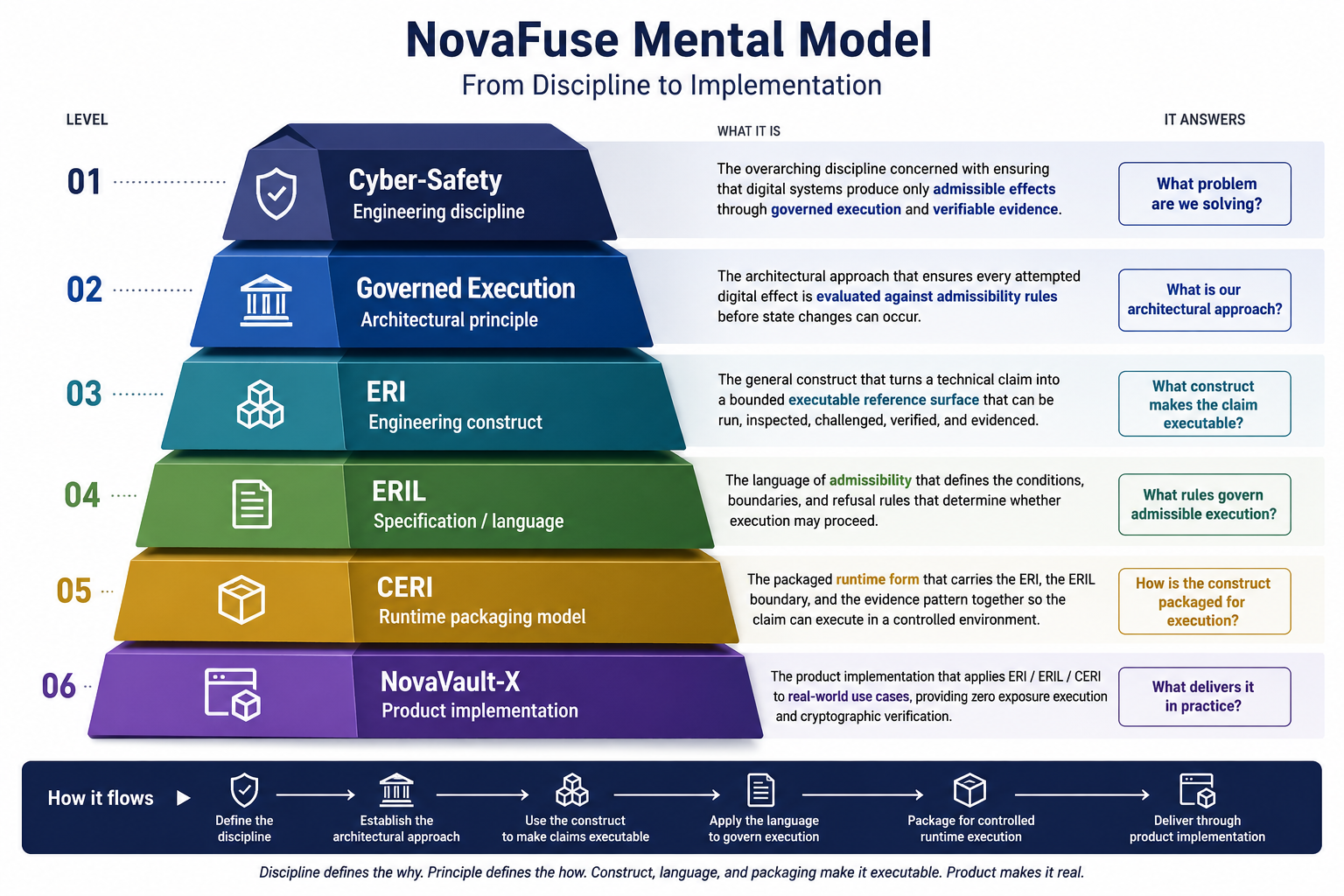
Cyber-Safety applies safety engineering principles to digital systems by defining the standards, boundaries, and mechanisms required for powerful digital capabilities to operate safely.
A conceptual rulebook and governance philosophy defining constraints over admissibility. It defines what is allowed to occur when digital systems attempt real-world effects.
The active engineering architecture (utilizing PEPRG lifecycles and IDNA models) that executes and enforces the discipline's rules at the exact millisecond of action.
This is not incremental improvement. It is a change in system ontology — from post-state interpretation of reality to pre-state constraint of the possibility space.
That shift is categorical, not incremental. Non-admissible transitions cannot become valid committed outcomes inside a NovaFuse-governed execution path. This is not a better version of the correction model. It is a different kind of system.
Every deployment operating inside a NovaFuse-governed execution boundary satisfies all four simultaneously — at runtime, not at audit time.
Collapse GRC, IT, and cybersecurity into one deterministic runtime decision loop. Here is how the lifecycle executes:
An agent, user, or system initiates a state change (e.g. file write, API transfer, network transition).
The boundary gateway intercepts the attempt and evaluates it against execution-time admissibility rules.
The gateway commits admissible effects and refuses non-admissible effects before the action is executed.
A cryptographic proof package is emitted at resolution, proving exactly what was checked, committed, or refused.
Cybersecurity, GRC, and IT remain essential disciplines. Cyber-Safety adds the capability that lets their requirements converge at runtime: one governed decision before a digital action changes state.
| Capability | Existing Capabilities | Cyber-Safety Capabilities |
|---|---|---|
| Know | Know who has access and which policies apply. | NCKnow what effect is being attempted across Identity, Data, Networks, and AI. |
| Decide | Approve access, tickets, and controls in separate workflows. | NCMake one runtime admissibility decision before the effect completes. |
| Execute | Allow actions once access is granted, then monitor behavior. | NCCommit admissible effects and refuse non-admissible effects before state change. |
| Prove | Reconstruct logs and audit trails after execution. | NCEmit evidence as part of the commit or refuse decision. |
Agents need runtime authority boundaries before they invoke tools, APIs, or transactions.
Policy should become executable at the moment of action, not only documented after review.
Operations need evidence without slowing the system down or multiplying manual checkpoints.
Threat prevention becomes one input into a broader runtime admissibility decision.
Receipts should come from runtime evidence, not reconstruction after the effect has already happened.
AI agents call APIs. APIs modify records. Services exchange data. Models trigger decisions. Automations move money, approve access, route work, and change operational state. The question is no longer only whether a user was authenticated. The question is whether the effect itself was admissible.
An authenticated actor can still attempt an unsafe action, cross a policy boundary, or trigger an effect outside its authority.
Retrospective audit can explain what happened. Cyber-Safety asks whether the action should have been allowed to happen at all.
Agents and automated workflows can create new action paths. Governance has to travel with the interaction, not chase it afterward.
The strongest assurance is emitted at the moment of execution, bound to the actor, input, environment, decision, and outcome.
It does not ask enterprises to merge departments. It lets governance, operations, and security remain distinct disciplines while their requirements converge at the point where a digital action is about to produce an effect.
Cyber-Safety does not exist to slow useful work. It exists to make more powerful digital work possible by making the boundary of acceptable action explicit, executable, and evidenced.
A digital effect is allowed only when the required identity, data, network, AI, policy, and integrity conditions are satisfied for that moment.
A deployment does not execute unless policy, identity, code integrity, and environment state are simultaneously satisfied.
An AI agent cannot invoke a financial or operational transaction unless its authority boundary admits the attempted effect.
Software can be verified and evaluated without exposing implementation custody, as in NovaVault-X Proof Runs.
Runtime receipts bind what was attempted, what was admitted or refused, and what result was produced.
A Cyber-Safety workflow does not wait for audit to reconstruct what happened. It asks the admissibility question at the point of attempted effect, then commits or refuses with evidence.
Traditional systems verify the AI has access. Cyber-Safety asks a different question: Should this payment be allowed under the current identity, data, network, AI authority, and policy conditions?
Cyber-Safety does not evaluate whether the model is intelligent. It evaluates whether this specific action is admissible under the current runtime conditions.
Cyber-Safety has a growing technical language. The public page should orient the reader, not force them to learn the whole ontology at once.
Defines the four surfaces every digital interaction spans: Identity, Data, Network, and AI.
Defines when governance occurs: before execution, during execution, and after execution evidence is produced.
Represents the bounded event in which an admissible interaction is executed and evidenced.
Represents an atomic digital action that can be admitted, refused, and evidenced.
Formalizes how Cyber-Safety claims become executable, testable, and verifiable.
Applies Cyber-Safety to software IP evaluation through sealed artifacts, protected execution, and receipts.
A protocol-level reference architecture defining Cyber-Safety as a runtime discipline, including invariant enforcement and authority boundaries.
Evidence is generated by the system instead of reconstructed manually after the fact.
Data, software, and authority can be evaluated inside boundaries instead of transferred broadly.
Requirements are checked at the moment of action, not remembered later as documentation.
AI and automated workflows can act with explicit admissibility boundaries and verifiable receipts.
The white paper defines the paradigm: Cyber-Safety as the unification of GRC, IT, and Cybersecurity at the attempted effect. The technical reference defines Operationalized Cyber-Safety as a bounded runtime admissibility architecture. The lexicon stabilizes the canonical vocabulary.