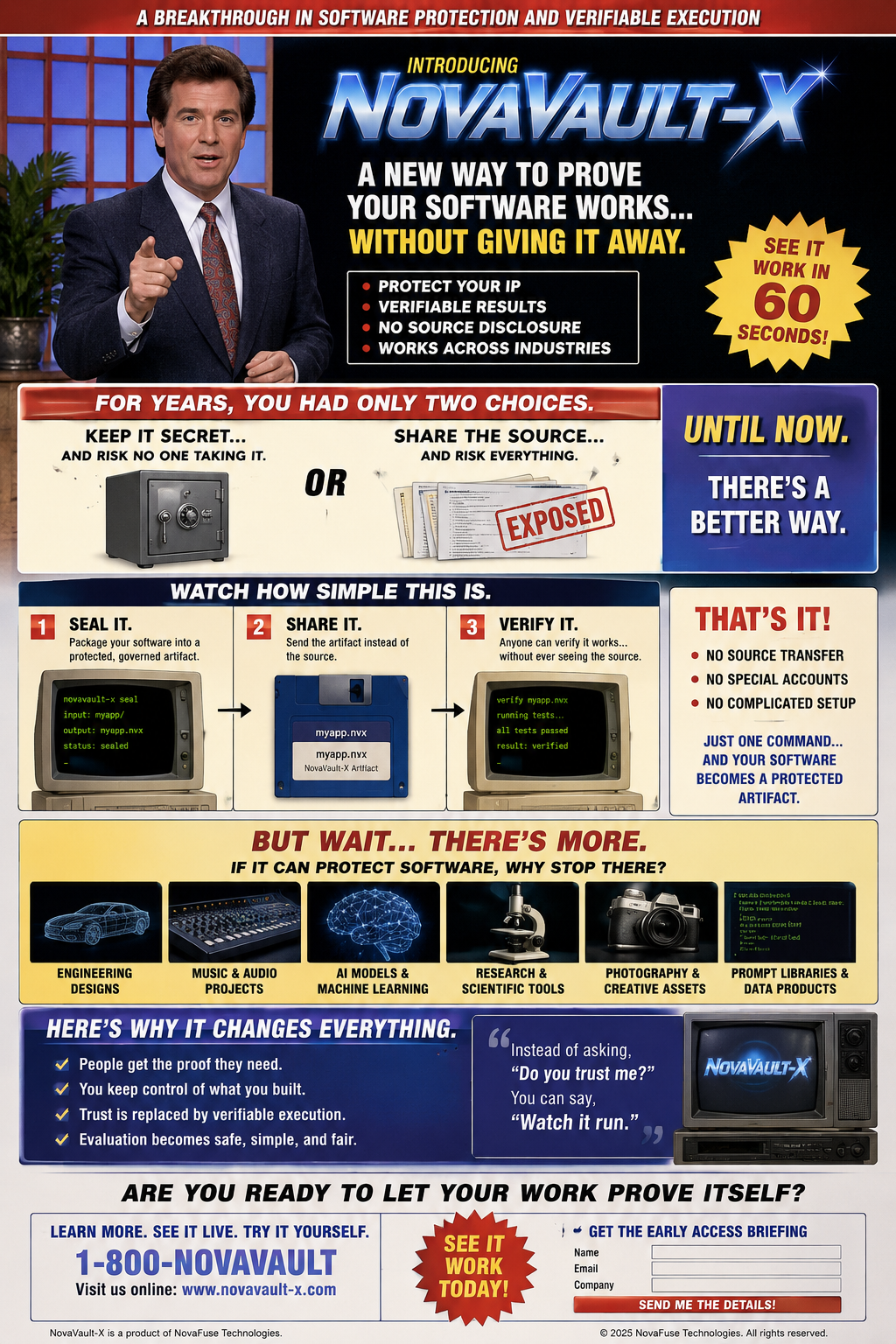
A new way to use your software IP
without giving it away.
Until now, proving software meant exposing software. NovaVault-X introduces protected evaluation: use without possession.
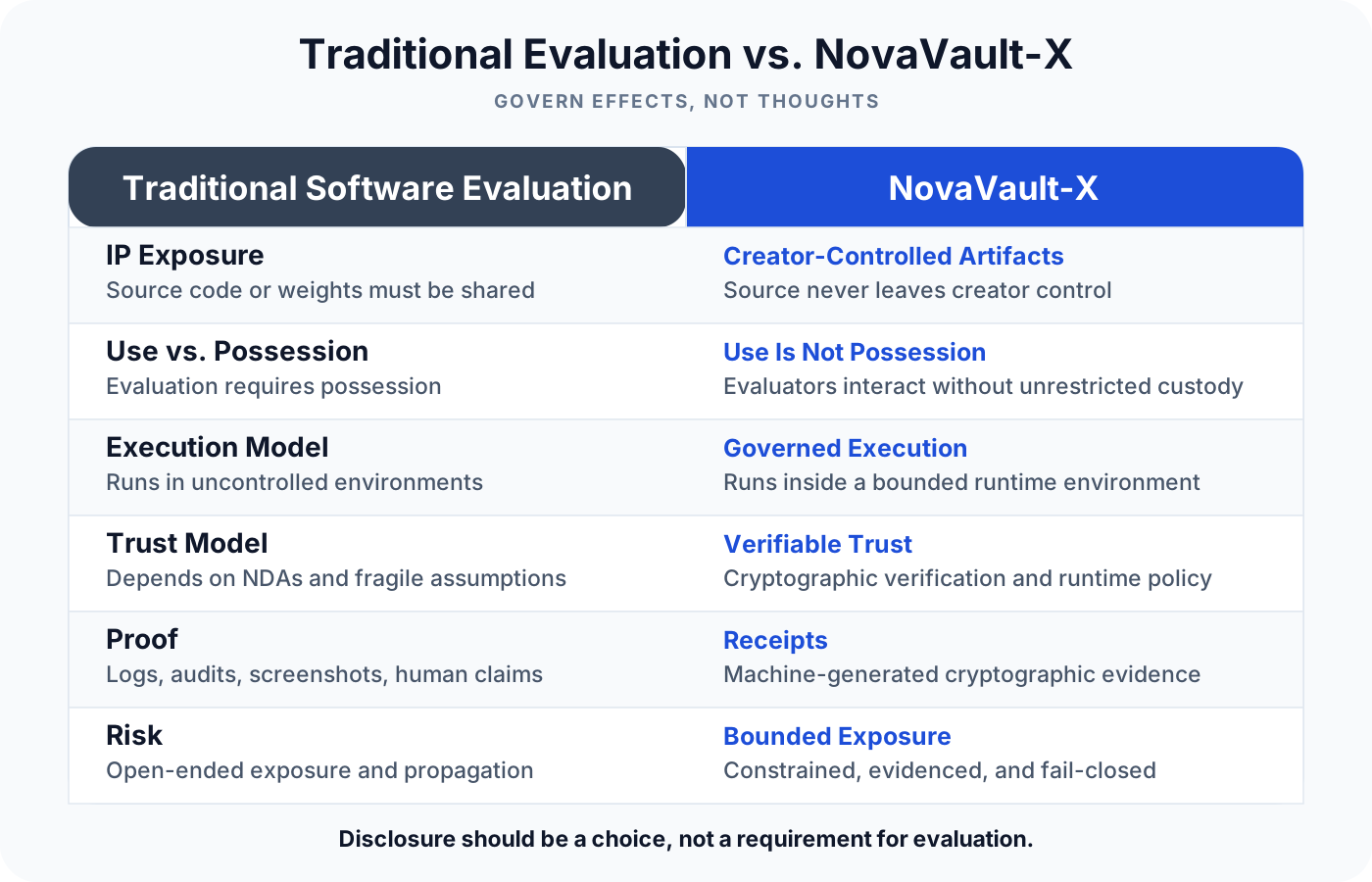
Legal agreements, demos, screenshots, and source-code review all have a place. NovaVault-X decouples proof of behavior from disclosure by adding the capability to run and verify protected work without transferring source custody.
| Capability | Existing Capabilities | NovaVault-X Capabilities |
|---|---|---|
| Protect | Keep work secret or disclose it under legal protection. | NCSeal work into a protected package. |
| Share | Share a demo, screenshots, limited trial, environment access, or source code. | NCShare a verifiable package without source custody transfer. |
| Evaluate | Ask the reviewer to trust a demo or inspect the implementation. | NCLet the reviewer run and verify inside a defined boundary. |
| Prove | Support trust with notes, screenshots, logs, or manual review. | NCProduce a receipt that binds artifact identity, policy, input, output, execution context, and outcome. |
Before NovaVault-X, protected software evaluation usually forced a choice.
or
Share
and
Share
You built something valuable.
Until now, proving it meant exposing it.
It could be a fraud detection model, a pricing algorithm, or a document classifier.
✗ If you share the code
- You've given it away. Once it's on their machine, it's gone.
- No NDA protects a trade secret that can be memorized or reimplemented.
- Patents take years, cost six figures, and force you to publish the exact thing you're protecting.
- They can rebuild it. You can't un-share it.
✓ NovaVault-X: Use Without Possession
- Seal the work into a protected
.nvxpackage. - Let the evaluation happen inside a defined boundary.
- Produce a receipt that binds policy, input, output, logic identity, and execution context.
- Move the conversation from trust to evidence.
Key Technical Mechanisms
Converts software, AI models, and data assets into cryptographic execution proofs so third parties can verify behavior without seeing the underlying mechanics.
Provides a sandboxed runtime layer where users can interact with and test the asset without downloading, cloning, or scraping the underlying intellectual property.
Turns computation into clean, provable execution events that can validate compliance, functionality, and performance while preserving policy boundaries, execution context, infrastructure privacy, and source-data privacy.
Primary Use Cases
Allows enterprises to benchmark, stress-test, and audit proprietary AI models without requiring weight files or training datasets to leave the host infrastructure.
Enables developers to let potential clients or auditors run comprehensive proof-of-concepts without revealing raw source code.
Supports multi-party verification and compute pipelines where raw inputs must remain hidden from other participants.
Seal locally. Verify anywhere.
The CLI creates the first proof object: a sealed artifact and matching hash anyone can verify locally. No account, no network call, no backend.
$ nvx seal my_fraud_detector.py
Sealing my_fraud_detector.py...
Artifact ID : nvx-e3cf20d72c50
Status : SEALED [OK]
Share this hash — it proves the logic existed, before you share anything:
e3cf20d72c50059304fb1a8e30ad50fae1ddb399ba02e0d981ccf93e5489339c
# Email them: artifact.nvx + the hash above. Source never leaves your machine.
# Step 2: Recipient verifies — on their machine, no accounts, no network
$ nvx verify-hash artifact.nvx --expected e3cf20d72c50...
========================================
NovaVault-X Hash Verification (Tier 1)
========================================
Artifact ID : nvx-e3cf20d72c50
Sealed At : 2026-04-25T02:20:51 UTC
Expected : 0xe3cf20d72c50...
Actual : 0xe3cf20d72c50...
Internal : INTACT
----------------------------------------
STATUS: VERIFIED [OK]
========================================
$ echo $?
0
NovaVault-X doesn't replace legal protection. It reduces how often you need to rely on it.
What NovaVault-X verifies — and what it doesn't
NovaVault-X verifies execution integrity, not execution intent.
A valid receipt proves what happened inside the declared execution boundary and that the sealed artifact remained intact.
It does not replace the human decision of whether the result should be commercially trusted.
Integrity proves what happened. A protected evaluation defines what is allowed to happen.
What a Proof Run proves.
A Proof Run is a bounded execution event that produces a cryptographically verifiable record of input, execution environment state, and output without transferring artifact custody.
What it proves
- Artifact integrity inside the defined system boundary
- That bounded execution occurred
- Policy boundary, input, output, and execution environment state were receipted
- Artifact custody did not transfer inside the Proof Run boundary
What it does not prove
- That the algorithm is commercially valuable
- That the output is universally true
- That the software is harmless in every possible context
- That observed behavior reveals nothing about the implementation
Take your software.
Seal it into a protected package.
This is the handoff: not a pitch deck, not a screenshot, not a fragile promise. The actual work becomes testable without becoming theirs.
Now seal it into a protected package - a secure, verifiable container of behavior.
The old question was, "Do you trust me?" The new answer is, "Watch it run."
- They get to watch it run.
- They can test it.
- They can challenge it.
- They can verify the results.
- But they never take possession.
Lock & Key is a NovaFuse Technologies capability artifact distributed for evaluation purposes. Use is governed by the NovaVault-X Evaluation Terms. Source code and runtime implementation are not included.
Ready for a protected evaluation?
For NovaVault-X inquiries, Proof Run intake, or artifact evaluation questions, contact NovaFuse Technologies at proofrun@novafuse.tech. Tell us what needs to be proven, but keep sensitive implementation details out of the form.
{
"schema_version" : "nvx-v0.2",
"proof_id" : "ab64cb4b-f8b2-4e1a-9c3d...",
"logic_hash" : "e3cf20d72c500593...",
"policy_hash" : "91d7a3c2b0ef442a...",
"input_hash" : "3cbc940d8a11f4c2...",
"output_hash" : "3c2d5b5e7a908f1d...",
"context_hash" : "7a8b2d4f10c63e91...",
"integrity" : "VERIFIED",
"source_exposed" : false
}
A receipt that proves what happened inside the PEPRG runtime boundary without exposing how the implementation works.
Software is only the beginning.
Anything that can be sealed can be used, evaluated, and verified without possession. If NovaVault-X can seal software, the same principle can extend to other high-value digital creations: AI models, music, photography, video, CAD files, research, datasets, and prompt libraries.
An .nvx package is not a file format. It is a new digital capability: protected evaluation without possession.
Protected Evaluation
For the first time, software can be used, challenged, verified, and evidenced without transferring possession of the underlying intellectual property.