Executable Reference Implementation
The bounded reference surface. It turns a technical claim into behavior that can be run, tested, inspected, challenged, verified, and evidenced.
Every technical claim creates a trust problem. When someone says, "our system guarantees X," how do you know before commitment?
Cyber-Safety defines the discipline. PEPRG defines when runtime governance occurs: before execution, during execution, and after execution evidence is produced. ERI, ERIL, and CERI make claims executable, governed, and packageable. NovaVault-X is one product implementation.
The page name is a stack, not a single acronym. ERI names the executable claim surface. ERIL names the admissibility language that governs the boundary. CERI names the packaged runtime form where the claim, controls, and evidence travel together.
The bounded reference surface. It turns a technical claim into behavior that can be run, tested, inspected, challenged, verified, and evidenced.
The language of admissibility. It defines the conditions, boundaries, and refusal rules that determine whether execution may proceed.
The packaged runtime form: a Containerized Executable Reference Implementation. After it satisfies a declared conformance profile and its required evidence is accepted, the same CERI may be designated a Certified Executable Reference Implementation. Packaging is not certification.
Documents, demos, simulations, POCs, and pilots all help evaluation. An ERI adds the capability to evaluate the claim through a bounded reference surface that can be run, inspected, challenged, verified, and evidenced.
| Capability | Existing Capabilities | ERI Capabilities |
|---|---|---|
| Frame | Express a claim through descriptions, presentations, demos, simulations, prototypes, POCs, and pilots. | NCFrame the claim as a bounded executable reference surface. |
| Run | Interpret the claim across multiple stages and artifacts. | NCRun the reference surface under declared conditions. |
| Challenge | Increase confidence through staged exposure before reliance. | NCTest behavior before commitment against the executable reference. |
| Prove | Assemble evidence from tests, trial notes, and implementation review. | NCEmit evidence from execution of the reference boundary. |
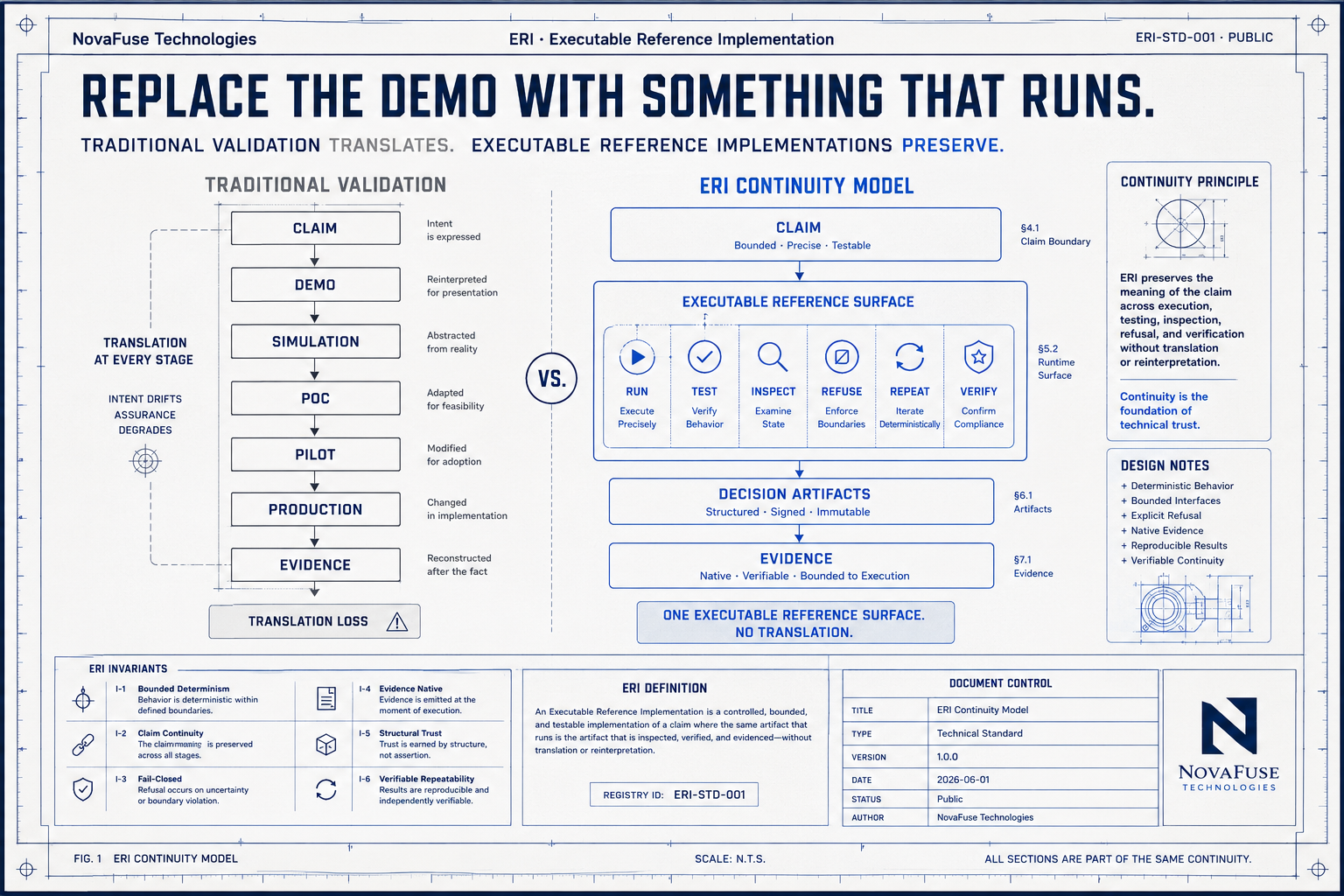
Most validation fragments the original claim across descriptions, presentations, demos, simulations, prototypes, and pilots. Each stage is a translation. By the time the system reaches production, the claim may have been rebuilt so many times that fidelity is hard to prove.
In enterprise evaluation, this usually becomes staged exposure: demos, sandboxes, pilots, limited trials, and restricted deployments. Those stages exist because the claim cannot yet be directly executed and inspected before commitment.
The claim is explained, summarized, and interpreted before anyone can inspect behavior.
The claim is shown through a partial or staged version that may not preserve production meaning.
The claim becomes one bounded surface that can be run, tested, inspected, challenged, verified, and evidenced.
Imagine an architect claiming they designed a perfect building. Traditional validation gives you drawings, renders, models, videos, and mock-ups. An ERI gives you the reference building: bounded, inspectable, and measurable.
Useful, but each one is an interpretation of the design claim.
Closer, but still not the thing itself.
You hope production preserves the meaning of every prior artifact.
That reference building is the ERI. It does not merely describe the claim. It lets the claim be inspected through bounded behavior.
The ERI continuity model shows the shift in one view: traditional validation translates the claim at each stage, while an ERI executes the claim within a declared boundary and produces evidence from that execution.
To govern digital systems at scale, technical claims must be auditable without exposing proprietary code. NovaFuse separates the public, portable behavior specification from the private implementation mechanics.
The ERI acts as a specification-locked execution contract. It defines required system behavior, invariants, admissibility rules, and evidence schemas without exposing the internal implementation.
The execution substrate that satisfies the ERI contract. It implements the active enforcement, control flow, sequencing optimizations, and cryptographic proof-generation pipelines.
Why this split matters: It provides a way to verify system behavior without disclosing private execution mechanics. The ERI defines the contract that NovaVault-X must satisfy at runtime. Audit becomes a verification of the portable contract, leaving the implementation detail secure.
An ERI can be used anywhere a claim needs to become executable. Another organization might use the construct for engineering validation, scientific reproducibility, financial modeling, simulation fidelity, or any other domain where a claim should be run instead of merely described.
The broad construct: turn a claim into bounded behavior that can be run, inspected, challenged, verified, and evidenced.
NovaFuse applies ERI to PEPRG runtime governance: admissibility, authority, runtime boundaries, refusal, decision artifacts, and evidence chains.
NovaFuse products can instantiate ERIs for protected evaluation, PEPRG runtime governance, and other bounded claims.
ERI defines the general construct. NovaFuse ERI applies that construct to governance. ERIL defines admissibility. CERI defines the contained runtime package; containerization is one possible implementation, not the acronym. NovaFuse uses ERI for governance, but the construct itself is broader than any one discipline or product.
The domain-agnostic construct: a claim becomes bounded behavior that can be run, tested, inspected, challenged, verified, and evidenced.
A semantic governance language for admissibility. It does not tell software how to compute. It conditions whether execution is allowed to cross a defined boundary.
CERI names two linked stages. Containerized Executable Reference Implementation is the packaged executable boundary where contract, runtime behavior, and evidence travel together. Certified Executable Reference Implementation is a conformance status earned only when that package satisfies its declared profile and the required evidence is accepted.
An ERI executes the claim under declared conditions and produces evidence from that execution. Because the same executable reference is run, tested, inspected, challenged, and verified, the meaning of the claim is preserved from definition to evidence.
The system declares what it can prove by running, not just what it asserts in writing.
The ERI states the conditions under which the claim is being executed, tested, and evidenced.
The output is evidence from the reference behavior itself, not a retrospective explanation of a separate demo.
ERI does not eliminate assurance work. It changes the work from reconstructing claims to verifying executable evidence.
Documents, demos, tests, audits, logs, and production behavior all have to be reconciled to determine what the system actually did.
The claim moves closer to the system itself because it can be run, inspected, challenged, and evidenced inside a declared boundary.
ERI reduces dependence on interpretation layers by making the reference behavior observable and evidence-producing.
ERI conformance is not a marketing label. A system must satisfy bounded scope, deterministic behavior within its declared envelope, explicit decision logic, fail-closed behavior, and sufficient artifacts for independent verification.
Start with the ERI Primer for a developer-level introduction. The reference blueprint defines the execution model. The ERIL specification defines the admissibility constraint logic and revocation standards. The lexicon stabilizes the canonical vocabulary.
A generalized executable reference system showing how ERIs, governance invariants, and identity gating compose into a unified runtime.
A minimal reference surface illustrating how external systems interface with PEPRG runtime governance layers without bypassing controls.